
Supreme Court Considers Nationwide Guidelines for Protests
The Supreme Court on Monday indicated that it may frame nationwide guidelines for handling public protests, stressing that authorities must protect the constitutional right to peaceful demonstration while preventing violence and excessive police action.
A bench led by Chief Justice of India Surya Kant, along with Justices Joymalya Bagchi and V. Mohana, heard several petitions concerning protests over the alleged examination paper leak controversy. The petitions also raised concerns about the police response to the July 20 “Sansad Chalo” student march at Delhi’s Jantar Mantar and incidents reported in Bihar.
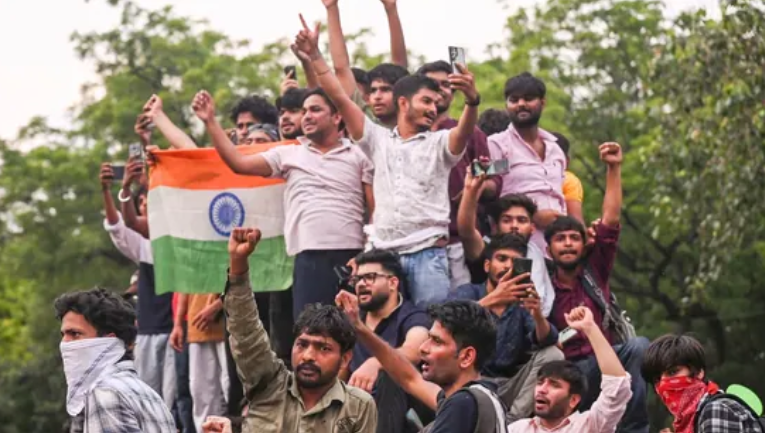
Supreme Court Seeks Balance Between Protest and Public Order
The bench stressed that the Constitution protects peaceful protests and that authorities cannot restrict demonstrations simply because people choose to raise their voices.
At the same time, the court said protesters must maintain peace and follow the law. CJI Surya Kant remarked, “It cannot be that there is an agitation and hence a lathi charge. It can also not be that violence occurs in these protests.”
The court said it would examine both allegations of police excesses and incidents of violence by protesters.
Court Considers Uniform Protest Guidelines
The judges indicated that India may need a uniform protocol for public protests. Such guidelines could help authorities protect citizens’ fundamental rights while maintaining public order.
The Chief Justice said authorities should allow peaceful demonstrations that follow required permissions and take place at designated locations. He also said authorities could deal separately with individuals who create violence or disrupt public order.
Petitions Raise Concerns Over Police Action
Advocate Fauzia Shakil, representing Rajya Sabha MP Manoj Jha, told the court that a comprehensive petition highlighted alleged police action during the protests.
She also referred to claims involving police firing on protesters in Siwan, Bihar, and allegations that authorities used AK-47 rifles during the incident.
Another lawyer asked the court to hear petitions filed by students and their families together so that the court could address similar allegations consistently.
Supreme Court Examines Police and Protester Conduct
The bench said it would consider concerns involving both protesters and police officers.
Justice Joymalya Bagchi pointed out that police personnel can also suffer injuries while controlling large gatherings. He questioned whether authorities provide officers with adequate protective equipment, including helmets, guards and other safety gear.
The judges stressed that both sides must follow discipline during demonstrations.
Court Stresses Discipline During Demonstrations
CJI Surya Kant said “self-imposed discipline” plays an important role in a democratic protest. He explained that responsible conduct allows citizens to exercise their right to dissent without putting public safety at risk.
Senior advocate Vikas Singh also urged the Supreme Court to establish pan-India norms that balance the right to protest with the need to maintain law and order.
Delhi Police Agrees to Joint Hearing
Solicitor General Tushar Mehta, representing the Delhi Police, told the court that the police had no objection to combining the related petitions. He also said the authorities would assist the court in examining the issues.
The Supreme Court then decided to list the connected petitions together. The bench said it would examine the allegations objectively and determine whether authorities committed any excesses while managing the demonstrations.
Protests Over Examination Paper Leaks
The case comes amid continuing protests over alleged examination paper leaks and demands for greater accountability in the education system.
The demonstrations have already triggered major political developments, including the resignation of former Education Minister Dharmendra Pradhan after weeks of protests.
As the Supreme Court considers nationwide protest guidelines, its eventual directions could establish clearer standards for both demonstrators and law enforcement agencies during public gatherings.